

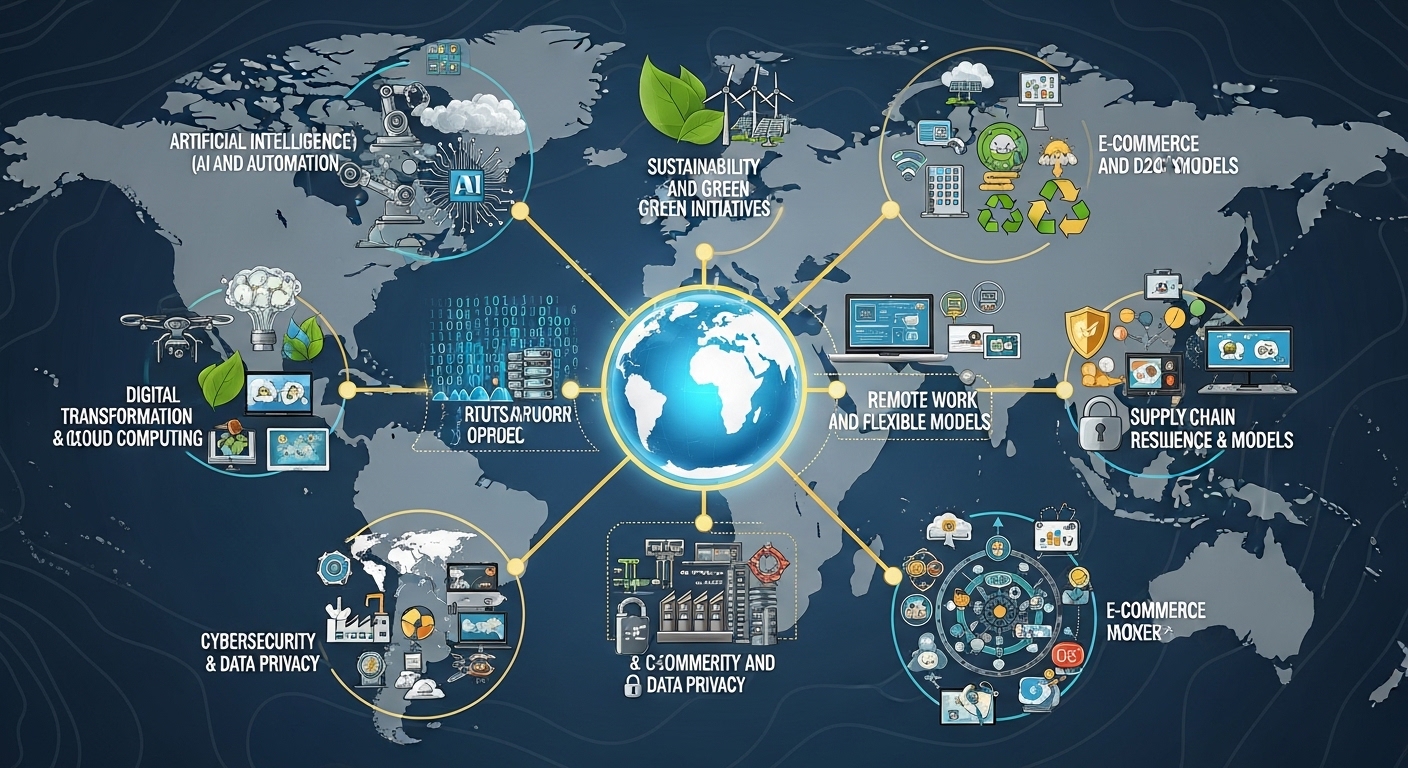
The global economy is evolving rapidly as businesses adapt to artificial intelligence, shifting supply chains, sustainability demands, and changing consumer behavior. In 2026, success is no longer defined only by scale, but by agility, digital capability, and long-term resilience. These business trends are reshaping how companies operate, compete, and grow across international markets.
Artificial Intelligence Driven Business Growth
AI Powered Decision Making
Artificial intelligence is transforming how companies make decisions by analyzing massive datasets in real time. Businesses now use AI to forecast demand, reduce risks, and improve strategic planning across finance, marketing, and operations, increasing efficiency and competitiveness in global markets.
Automation Of Business Processes
Automation is replacing repetitive tasks across industries such as manufacturing, logistics, and customer service. This improves productivity, reduces operational costs, and minimizes human error, allowing companies to focus more on innovation and growth.
AI In Customer Experience
Companies are using AI to personalize customer interactions through chatbots, recommendation systems, and predictive analytics. This enhances customer satisfaction and strengthens brand loyalty in highly competitive markets.
Intelligent Supply Chain Systems
AI-driven supply chains help businesses predict disruptions, optimize inventory, and improve logistics efficiency. This creates more resilient and adaptive global trade networks.
Human And AI Collaboration
Modern workplaces are increasingly combining human creativity with AI efficiency. This collaboration improves decision-making and allows businesses to achieve faster and more accurate results.
Global Trade And Supply Chain Transformation
Supply Chain Diversification
Companies are reducing dependency on single suppliers or regions to minimize risks caused by geopolitical tensions, pandemics, and economic instability.
Nearshoring And Regional Production
Businesses are shifting manufacturing closer to target markets to reduce costs, improve delivery speed, and strengthen supply chain control.
Global Trade Fragmentation
International trade is becoming more regional due to tariffs, political conflicts, and changing economic alliances, reshaping global commerce patterns.
Logistics Digitalization
Advanced logistics systems use AI, tracking tools, and automation to improve delivery speed, transparency, and efficiency across global networks.
Resilient Supply Networks
Companies are redesigning supply chains to withstand shocks and disruptions, ensuring stability in uncertain global conditions.
Financial Market Evolution
Algorithmic Trading Growth
Financial markets are increasingly dominated by algorithmic trading systems that execute transactions based on real-time data and predictive models.
Rise Of Private Capital
Private equity and venture capital investments are expanding as investors seek higher returns in emerging industries and startups.
ESG Investment Expansion
Environmental, social, and governance investing is becoming mainstream, influencing corporate behavior and long-term investment strategies.
Digital Assets And Blockchain
Cryptocurrencies and blockchain-based systems are evolving with increased institutional adoption and regulatory development.
Interest Rate Impact On Markets
Changing interest rates continue to affect borrowing costs, investments, and overall economic growth worldwide.
Sustainability And Green Economy Shift
Carbon Neutral Business Models
Companies are adopting carbon neutrality goals by reducing emissions and investing in clean technologies to meet global sustainability targets.
Renewable Energy Investment Growth
Businesses are increasing investments in solar, wind, and clean energy systems to reduce reliance on fossil fuels.
Sustainable Supply Chains
Companies are redesigning supply chains to reduce waste, improve efficiency, and meet environmental regulations.
Climate Risk Integration
Organizations are treating climate change as a financial risk and incorporating it into long-term planning.
Green Innovation Development
New sustainable technologies are creating opportunities in clean manufacturing, recycling, and environmental management.
Digital Transformation Of Industries
Cloud Computing Expansion
Cloud platforms are enabling scalable, flexible, and cost-efficient business operations across global organizations.
Cybersecurity Investment Increase
Businesses are investing heavily in cybersecurity to protect against rising cyberattacks and data breaches.
Digital Payment Systems Growth
Cashless payments, mobile wallets, and fintech platforms are rapidly expanding across global markets.
5G Enabled Business Models
5G networks are supporting real-time communication, smart devices, and industrial automation worldwide.
Data Driven Enterprises
Companies are increasingly using real-time data analytics to improve decision-making and customer targeting.
Corporate Strategy And Market Competition
Global Mergers And Acquisitions
Companies are merging or acquiring competitors to expand market share, technology access, and global reach.
Startup Ecosystem Growth
Startups are driving innovation in AI, fintech, healthcare, and e-commerce with strong investor support.
Customer Centric Business Models
Businesses are focusing on personalized experiences to improve customer satisfaction and loyalty.
Workforce Transformation Trends
Automation and remote work are reshaping job roles, skill requirements, and organizational structures.
Global Brand Competition
Companies are competing through innovation, digital presence, and sustainability-focused branding strategies.
Emerging Markets And Global Expansion
Asia Economic Leadership
Asian economies are driving global growth through manufacturing strength, technology innovation, and rising consumer demand.
Africa Investment Growth
Africa is attracting foreign investment in infrastructure, energy, and digital transformation sectors.
Latin America Trade Expansion
Latin American countries are strengthening trade networks and industrial development initiatives.
Cross Border Business Growth
Companies are expanding internationally to diversify revenue streams and reduce regional risks.
Global Capital Flow Shift
Investment is increasingly moving toward emerging markets with high growth potential.
Future Business Landscape
AI Driven Enterprises
Businesses are evolving into AI-powered systems where automation supports most operational processes.
Hyper Digital Economies
Global economies are shifting toward fully digital ecosystems powered by fintech, e-commerce, and cloud computing.
Sustainable Growth Focus
Future business success depends on balancing profitability with environmental and social responsibility.
Global Risk Management
Companies are prioritizing geopolitical, financial, and cyber risk strategies to ensure stability.
Innovation Led Competitiveness
Continuous innovation remains the key driver of long-term business success in global markets.
FAQs
What are the top business trends today?
AI adoption, sustainability, digital transformation, and supply chain restructuring are key trends.
Why is AI important in business?
It improves efficiency, automation, and decision-making across industries.
What is ESG investing?
It focuses on environmental, social, and governance responsible investment strategies.
How are supply chains changing?
They are becoming more regional, digital, and resilient.
What drives global business growth?
Technology, emerging markets, and innovation are major drivers.
Conclusion
Top business trends show a clear shift toward intelligent automation, sustainability, and digital transformation. Companies are becoming more data-driven, resilient, and globally connected to survive in a fast-changing economy. As innovation accelerates, the global business landscape will continue evolving toward smarter, greener, and more adaptive systems that define the future of economic growth.
